Entry 20: The Unplayable 1864

Civil War Generals 2: Grant, Lee, Sherman. Designed by  Douglas Gonya.

Release Date: October 31, 1997.

Available Here

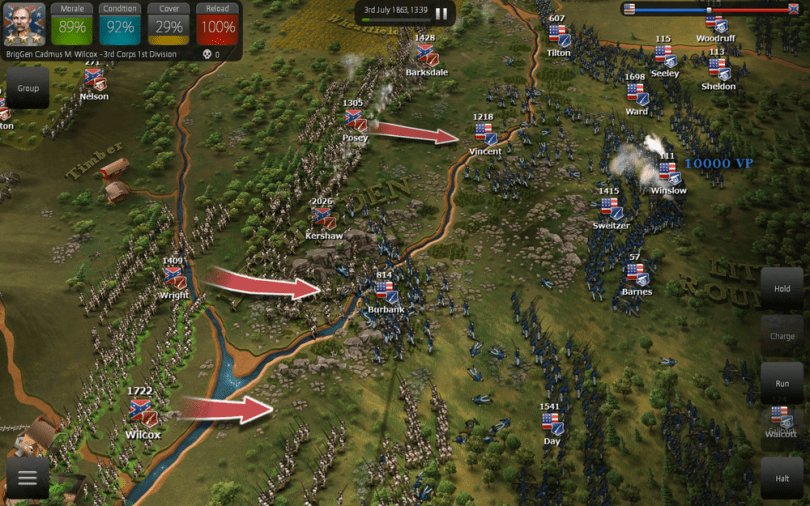
There are a lot of Civil War games out there. I’ve only played a few but I spent an enormous amount of time with one of the best: Civil War Generals 2: Grant, Lee, Sherman. When I discovered this game, I was at the height of my love affair with the epic military narrative I described in my last post, so being able to lead my forces through almost all of the war’s major engagements certainly scratched the right itch. But that’s not really what I want to talk about here, nor do I want to discuss how it possesses many of the same historical and moral problems I covered in my review of Ultimate General: Gettysburg. Revisiting CWG2 for this blog, one aspect stood out like a sore thumb: the strange way it ends. Read More

Ken Burns Made Me A Civil War Historian

Today marks the 25th anniversary of the first airing of Ken Burns’s The Civil War. My original plan was to mark the occasion with a review (or series of reviews) because I have lots of opinions on it (for instance, I both agree and disagree with Kevin Levin’s recent article). Unfortunately, I don’t have time to watch it again and it’s been too long since my last viewing for me to write a proper entry. I’ll get to that someday, but today I want to say a little about my personal relationship with the film. For me, The Civil War isn’t just any documentary–it directly inspired me to pursue American history as a career. Read More

Entry 19: Lincoln Begins


The Better Angels. Written and directed by A. J. Edwards.

Release Date: November 7, 2014.

“The short and simple annals of the poor”; this is how Abraham Lincoln described his childhood (quoting Thomas Gray’s “Elegy Written in a Country Churchyard”) and A. J. Edwards apparently believes him. Edwards’s debut film, The Better Angels, begins by establishing the contrast between Lincoln’s humble roots and the eventual heights he would reach–letting us hear the sound of a frontier river (probably Pigeon Creek) before presenting several imposing shots of the Lincoln Memorial. The river is a good metaphor: it is part of the rustic uncivilized world but always moving forward, just like Lincoln as he moved from rural Indiana to the pinnacle of the American social ladder. Read More

Entry 18: The Plastic Punk Goes Confederate

Billy Idol, a British rock star, even displays the Confederate flag on his guitar.

“Rebel Yell,” Billy Idol. Produced by Keith Forsey. Written by Billy Idol and Steve Stevens.

Release Date: October 24, 1982.

I recently reviewed Craig A. Warren’s The Rebel Yell: A Cultural History for The Register of the Kentucky Historical Society. I liked the book and my review is largely positive, but there’s one aspect I’d like to discuss here because it pertains directly to Civil War memory in popular culture. Warren commendably incorporates “Rebel Yell,” Billy Idol’s most famous tune (with the possible exception of his cover of “Mony Mony”), into his study but I disagree with Warren’s interpretation of the lyrics. This was too small an issue to warrant a lot of attention in my review, but it seemed like good fodder for a blogpost–especially since there’s some overlap with my previous discussion of the Confederate flag. Read More

Entry 17: The Battle of Hazzard County

The Dukes of Hazzard, “Treasure of Hazzard,” Season 2, Episode 16. Directed by Hollingsworth Morse. Written by Gy Waldron, William Raynor, and Myles Wilder.

Release Date: January 25, 1980.

Available here

In the aftermath of the Charleston shooting, I (like everyone else) wrote a piece about the Confederate Battle Flag. In part, I argued there was a brief period in the mid-to-late 20th century when popular culture appropriated the flag as merely a symbol of rebellion and the South, ostensibly devoid of any white supremacist connotations. I highlighted The Dukes of Hazzard as one of the primary examples of this phenomenon. The show subsequently became a focal point of this ongoing debate when TV Land pulled it due to the prominent placement of the flag on the roof of the Duke brothers’ famous car, “The General Lee.” The show indirectly also made news when Ben Jones–who played Cooter and, until recently, served as the “Chief of Heritage Operations” for the Sons of Confederate Veterans–made himself one of the flag’s most vocal defenders. In the wake of these developments, I decided to watch an episode for the first time in 30 years to measure how much Civil War memory really influenced the show. The second season episode, “Treasure of Hazzard” seemed like a good place to start, since it’s apparently the only episode that directly uses the war as a plot point. Read More

Entry 15 (Part 3): In Praise of Gettysburg

Some of you thought I was too hard on Gettysburg, especially in my first post. I’ve often complained that historians judge historical films unfairly, and maybe I’ve been a little guilty of that–at least where Gettysburg‘s concerned. So, to make amends (and because I know you are all dying for even more Gettysburg content), here’s a list of things I like about the movie. Taken together, they show why I would still recommend the film, despite some of its historical problems. Read More

Entry 15 (Part 2): Is Gettysburg a Lost Cause Film?

Gettysburg

“We should have freed the slaves, then fired on Fort Sumter.”

This is the line–spoken by Longstreet to Fremantle–that has haunted historians and fans of Gettysburg for 22 years. It’s built on so much faulty and potentially pro-Confederate history, some viewers see it as a clear sign Gettysburg is a Lost Cause film, plain and simple. Maxwell’s disastrous prequel, Gods and Generals, reinforced this view by depicting its Confederate characters through a clearly Lost Cause lens. It’s evident Gettysburg draws some of its inspiration from pro-Confederate myths, but I’ve always thought its overall approach to the Civil War is more nuanced. I kept this in mind during my recent viewing in an attempt to answer one of the central questions revolving around this movie: Is Gettysburg a Lost Cause film? Read More

Seriously Apple? No Confederate Flags in Video Games? (Updated)

Update: It looks like cooler heads may be prevailing and apparently Apple is working to restore some of its apps that use the flag “for educational or historical uses.” No news of Ultimate General: Gettysburg being restored as of yet. New of the game’s removal was surely responsible for the turnaround, as it went viral quickly and even Rolling Stone reported on it this morning. I’ll keep you posted as I hear more about it.

Update 2: Ultimate General: Gettysburg just announced on Facebook that it was able to negotiate with Apple and is now available again as an App, unchanged. Although Apple should never have pulled the game in the first place, I commend the company for recognizing the mistake and respecting Game-Labs’s artistic integrity.


Earlier today, Apple announced that it is no longer going to offer apps in its iOS store that feature the Confederate Battle Flag. I don’t know precisely how many apps this covers, but I do know that it includes Ultimate General: Gettysburg, which I reviewed on this site in February. According to the game’s developer Nick Thomadis, Apple will agree to restore the game if his company, Game-Labs, removes all Confederate flags. Thomadis refused and, although I support most of the efforts to remove Confederate iconography currently going on across the nation, I completely support Thomadis in this decision. Read More

On the Confederate Battle Flag

Dukes of Hazzard: Return of the General Lee - PS2 Artwork

In the wake of last week’s horrifying tragedy in Charleston, SC, there has been a long overdue widespread discussion about public displays of the Confederate Battle Flag. I’m reluctant to add to the conversation because it’s becoming cacophonous and I’m generally in line with those who believe that the flag, like the Confederacy it represents, is inseparable from its white supremacist origins (there have been an absolute flood of articles and think-pieces about the flag since the shooting, some of which are excellent, but I’ll just recommend Jon Coski’s wonderful book on the flag). Since then, South Carolina governor Nikki Haley has called for the removal of the flag in Columbia and, last night, Mississippi House speaker Philip Gunn requested a redesign of the state flag to eliminate the Confederate emblem. What truly shocked me, though, was Walmart and Ebay stating they will no longer carry any products that display the flag. With this development, the issue moved into the realm of popular culture and I thought I’d chime in on that score. Read More

Entry 15 (Part 1): Football Analysts and Generals

Gettysburg Movie Poster

Gettysburg. Written and directed by Ronald F. Maxwell. Based on the novel, The Killer Angels, by Michael Shaara.

Release date: October 8, 1993.

As I mentioned in my last post, Gettysburg is kind of a big deal in the Civil War community. I first saw it long before I imagined becoming a professional historian, so my views on the film have evolved as I’ve learned more about the war. However, the aspect that stood out during my most recent viewing was one that hadn’t struck me before: for a movie that includes so much depiction of and talk about death, it’s remarkably bloodless. Combat scenes that seemed impressively realistic twenty years ago now play more like sterile pageants. Maybe I was naive back then, but this is not the same war I read and write about now. So I began to wonder, is Gettysburg one of the prime culprits in propagating the “football analyst school” of Civil War history?

Read More